
Latest articles
Standardizing the Tax Exemption Procedure for Exported and Imported Goods under Decision No. 1768/QD-BTC

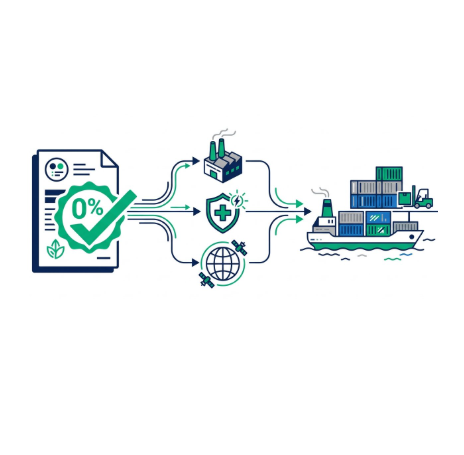
On July 2, 2026, the Ministry of Finance promulgated Decision No. 1768/QD-BTC announcing newly issued, amended, and supplemented administrative procedures in the customs sector, based on Circular No. 86/2026/TT-BTC dated June 30, 2026, stipulating tax administration for exported and imported goods. Specifically, the Tax Exemption Procedure for Exported and Imported Goods (Dossier Code 1.007659) has been restructured in accordance with Articles 14 through 28 of the Circular, settled by the customs authority where customs procedures are carried out or by the Ministry of Finance depending on the case, with zero fees or charges. Fully announcing the sequence, dossiers, timelines, and conditions helps ensure tax exemption policies are applied uniformly, to the right subjects, and within prescribed quotas.
From Policy to Procedure: Why Standardizing the Export and Import Tax Exemption Procedure Is Essential
Export and import duty exemption is a crucial policy instrument that supports production, investment, scientific research, environmental protection, and social security, while fulfilling international commitments and diplomatic policies. However, tax exemption only achieves its intended effectiveness when applied to the right subjects and within prescribed quotas, grounded in a transparent, accessible procedure backed by appropriate control mechanisms. As this domain involves numerous subject groups, diverse categories of goods, and multiple legal bases, it requires procedures to be consolidated and systematized scientifically.
The Tax Exemption Procedure for Exported and Imported Goods (Dossier Code 1.007659) is the sixth procedure in the amended and supplemented group, replacing the content previously announced at Ordinal Number 3, Section 1, Part I of Decision No. 912/QD-BTC dated April 14, 2026.
The content of the procedure is developed on the legal bases of Law on Customs No. 54/2014/QH13, Law on Tax Administration No. 108/2025/QH15, Law on Export and Import Duties No. 107/2016/QH13 (as amended and supplemented by Law No. 90/2025/QH15), Decree No. 134/2016/ND-CP, Decree No. 18/2021/ND-CP, and Articles 14 through 28 of Circular No. 86/2026/TT-BTC. Consolidating provisions scattered across multiple legal documents into a single procedure structured around all 11 content components—covering implementation sequence, methods, dossier components, settlement timelines, applicable subjects, settling authority, results, fees and charges, application forms, requirements and conditions, and legal bases—enables businesses and customs officers to look up information conveniently while enhancing publicity, transparency, and accountability.
Implementation Sequence: Taxpayer Self-Declaration, Customs Verification, and Prime Ministerial Decisions for Special Cases
A prominent feature of the procedure is the principle of taxpayer self-determination, self-declaration, and self-responsibility. In Step 1, the taxpayer self-determines and declares the goods and the exempted tax amount on the customs declaration when carrying out customs procedures, bearing legal responsibility for the declared contents; specifically, declaring the payable tax amount for goods exported or imported for processing supplied by the hiring party is excluded. This principle aligns with a modern tax administration model built on voluntary compliance, risk management, and post-clearance audit, while tying clear legal accountability to the declarant.
In Step 2, the customs authority where customs procedures are carried out relies on the tax exemption dossier and cross-checks it against current regulations to grant the tax exemption. Where imported goods are determined not to qualify for tax exemption as declared by the taxpayer, the customs authority collects the taxes and handles administrative violations (if any). For goods covered by a Duty-Free List, the Customs Electronic Data Processing System automatically deducts the exported or imported quantity corresponding to the quantity on the List. Where the List was notified in paper form, the customs authority performs updates and quantity deductions manually. For duty-free goods imported as combinations or production lines, the taxpayer carries out procedures at the customs authority where the machinery and equipment are installed and declares detailed goods on the declaration at the time of registration. Where detailed declaration is not possible, the taxpayer prepares an itemized list using Form No. 8, Appendix II via the System or using Form No. 31, Appendix I of Circular No. 86/2026/TT-BTC and attaches it to the declaration.
For exported and imported goods serving social security, overcoming the consequences of natural disasters, catastrophes, or epidemics, and other special cases, the sequence is designed toward rigorous appraisal at the central level. The taxpayer submits the tax exemption request dossier to the Ministry of Finance. Within 30 days from the date of receiving a complete dossier, the Ministry of Finance appraises the dossier and submits a written report to the Prime Minister, accompanied by a draft decision on export and import duty exemption prepared according to Form No. 26, Appendix I and a List of goods proposed for tax exemption (if any). For special cases requiring consultation with relevant Ministries and sectors, the appraisal timeline may be extended but shall not exceed 40 days from the date of receiving a complete dossier. Within 15 days from the date of receiving the appraisal document, the Prime Minister reviews and approves the tax exemption decision. Based on this decision and the customs dossier, the customs authority carries out export/import procedures and grants the tax exemption.
Specifically for goods imported to directly serve emergency relief requirements upon the occurrence of natural disasters, catastrophes, or epidemics, the procedure is streamlined. Based on the tax exemption request dossier, the customs authority where customs procedures are carried out settles the tax exemption immediately during customs procedures. This provision ensures timeliness, preventing administrative procedures from impeding relief efforts and demonstrating a rational differentiation among case groups.
Regarding implementation methods, the taxpayer declares complete and accurate information on the customs declaration and related documents in accordance with the data fields in Appendix II of Circular No. 86/2026/TT-BTC via the Customs Electronic Data Processing System. Where electronic declaration is not yet possible, the taxpayer submits digitally signed scanned copies. Where paper dossiers are submitted, documents required in original form must be submitted in person or via postal services; documents not required in original form may be submitted as copies.
Dossier Components and Tax Exemption Condition Groups: Covering Diverse Subjects with Specific Quotas
The tax exemption dossier first and foremost comprises the customs dossier pursuant to Law on Customs No. 54/2014/QH13 and its guiding implementation documents. Depending on the case, the taxpayer submits one of the following additional documents: export/import entrustment contracts; contracts for supplying goods under bid-winning or direct-contracting documents (where the supply price excludes import duty); contracts for supplying goods to organizations or individuals conducting petroleum operations; financial leasing contracts; documents transferring duty-free goods to another tax-exempt subject; the Duty-Free List already received by the customs authority accompanied by the Quantity Reconciliation Sheet; the Prime Minister's tax exemption decision; or a self-declaration and assumption of responsibility for specialized means of transport. Where the Duty-Free List was notified via the System, the taxpayer is not required to submit the List, as the customs authority utilizes the List on the System to execute the tax exemption.
The procedure further stipulates 14 specific cases, labeled from Point a to Point p, with dedicated supplementary dossier requirements:
- For goods of foreign organizations and individuals enjoying privileges and immunities: The dossier comprises the Duty-Free Quota Book, documents proving completion of re-exportation, destruction, or transfer, and relevant confirmation documents and tax exemption decisions as prescribed.
- For movable assets: The dossier comprises a work permit or equivalent document, a document proving termination of operations abroad, a passport or substitute document, a decision of the Minister of Finance for assets exceeding quotas, and personal identification number information.
- For gifts and presents: The dossier comprises a gift agreement document, a document from the managing agency, and a written confirmation from the Chairperson of the provincial/municipal People's Committee or managing Ministry/sector for gifts intended for humanitarian or charitable purposes.
The remaining specific cases encompass: goods bought, sold, or exchanged by border residents; goods exported for processing and imported processed products (declaring the number and date of the processing contract and the notified document confirming that exported products have a total value of natural resources and minerals plus energy costs below 51% of product cost); goods temporarily imported for re-export or temporarily exported for re-import (backed by a credit institution guarantee or deposit into the customs authority's account at the State Treasury); goods serving national defense and security; goods serving environmental protection; goods serving currency printing and minting (supported by a State Bank of Vietnam document); goods serving social security and overcoming consequences of natural disasters, catastrophes, and epidemics; agarwood from cultivated Aquilaria trees and python skins originating from captive breeding; unprocessed agricultural products invested in and cultivated with Vietnamese support in Cambodia; goods under international treaties; and on-spot export of processed products. Each group has its own dedicated list of supporting documents, enabling taxpayers to prepare accurate and complete dossiers right from the start.
The requirements and conditions section is systematized into 23 groups, from Section 9.10.1 to Section 9.10.23, specifying concrete quotas and criteria:
- Baggage of exiting and entering passengers: Upon each entry, duty-free allowances apply to liquor of 20% ABV or higher up to 1.5 liters, liquor under 20% ABV up to 2.0 liters, or alcoholic beverages and beer up to 3.0 liters; cigarettes up to 200 sticks, shredded tobacco up to 250 grams, or cigars up to 20 sticks; personal belongings suited to the trip's purpose; and other items with a total customs value not exceeding VND 10,000,000. Liquor, beer, and tobacco quotas do not apply to persons under 18 years of age. Pilots, international flight attendants, and certain other subjects are not entitled to regular baggage quotas, instead receiving a duty-free allowance once every 90 days.
- Gifts and presents: Goods with a customs value not exceeding VND 2,000,000—or exceeding VND 2,000,000 where total payable tax is under VND 200,000—are exempt from duty no more than 04 times per year. Gifts consisting of medicines and medical devices for patients suffering from diseases on the List of Critical Illnesses with a customs value not exceeding VND 10,000,000 are exempt from duty no more than 04 times per year.
- Movable assets: The quota is 01 unit or 01 set per organization or individual (excluding automobiles and motorcycles).
- Non-commercial goods: Samples with a customs value not exceeding VND 50,000 are exempt from duty; advertising publications under Chapter 49 are exempt provided each shipment contains only 01 type of publication and total weight does not exceed 01 kg.
- De minimis goods: Goods sent via postal or express delivery services with a customs value of VND 1,000,000 or less, or payable tax of VND 100,000 or less, are exempt from import duty; goods with a total customs value of VND 500,000 or less, or total payable tax of VND 50,000 or less per exportation or importation, are exempt from duty.
The remaining condition groups cover priority policy areas: goods imported for processing or export manufacturing; temporary import for re-export; goods creating fixed assets of investment-incentive beneficiaries; raw materials, supplies, and components not yet domestically produced within 05 years from official production commencement; petroleum operations; shipbuilding; plant varieties, animal breeds, fertilizers, and pesticides; scientific research and technological development; national defense and security; education; goods manufactured, processed, recycled, or assembled in non-tariff zones; medical device manufacturing; information technology, digital content, and software products; environmental protection; and currency printing and minting. Such systematization allows businesses to immediately identify the applicable policy group and avoid citing incorrect tax exemption grounds.
The dossier quantity is 01 set. Regarding timelines, the customs authority executes tax exemption within the customs procedure time limit pursuant to Article 23 of Law on Customs No. 54/2014/QH13; for goods serving social security, disaster/epidemic recovery, and other special cases, the Ministry of Finance completes appraisal within no more than 40 days from receiving a complete dossier, and the Prime Minister grants approval within 15 days from receiving the appraisal document. Implementing entities are organizations and individuals; settling authorities are the customs authority where customs procedures are carried out and the Ministry of Finance; outcomes comprise granting tax exemption based on the dossier, or issuing a notice of ineligibility, collecting taxes, and imposing penalties (if any). The procedure is accompanied by 09 forms (Forms No. 17, 18, 19, 25, 26, 27, 29, 30, and 31) and collects no fees or charges.
Policy Impact Assessment and Expected Performance Benchmarks
For taxpayers, the standardized procedure delivers three primary benefits. First is clarity: each tax-exempt subject group has its own dedicated list of documents, quotas, and conditions, enabling businesses and individuals to accurately determine their rights and obligations prior to initiating procedures. Second is convenience: tax exemption is granted right during customs procedures via the customs declaration and the Customs Electronic Data Processing System, minimizing separate standalone procedures. Third is predictability: the 30-day, 40-day, and 15-day timelines for cases submitted to the Prime Minister enable organizations and individuals to proactively plan schedules, especially for urgent relief and social security activities. Adding together the maximum timelines, total processing time at the central level is approximately 45 days, or approximately 55 days for cases requiring consultation with Ministries and sectors.
For regulatory authorities, the procedure provides a foundation for uniform nationwide enforcement of tax exemption laws. The principle of taxpayer self-declaration and self-responsibility, combined with customs verification and automated quantity deduction on the System, creates a "technical barrier" preventing excess imports, improper utilization, or abuse of tax exemption policies for fraud. Where goods do not qualify for tax exemption as declared, tax collection and penalties are immediately enforced, safeguarding state budget revenues and ensuring fairness among enterprises.
Based on procedural timelines, electronic transaction methods, and the 2025–2026 administrative reform orientation to cut at least 30% of compliance time and costs in line with Government Resolution No. 66/NQ-CP:
- Electronic processing rate: The rate of tax-exempt declarations filed and processed via the Customs Electronic Data Processing System is estimated to reach approximately 90% to 98%.
- On-time settlement rate: The rate of tax exemption dossiers settled within prescribed customs procedure timelines is estimated to reach approximately 98% to 100%.
- Time and compliance cost savings: Dossier preparation time for taxpayers is estimated to decrease by approximately 30% to 40%, while administrative compliance costs for printing, archiving, travel, and waiting times are estimated to drop by approximately 25% to 40%.
- Error reduction and nationwide rollout: The rate of declarations requiring amendment or explanation due to misdeclaring exemption subjects or quotas is estimated to fall by approximately 15% to 25% thanks to systematized conditions and quotas, while uniform workflow application across customs units nationwide is estimated to reach 100% from the effective date of the Decision.
Implementation Roadmap and Next Steps
The announcement of the Tax Exemption Procedure for Exported and Imported Goods under Decision No. 1768/QD-BTC demonstrates a consistent policy of linking institutional building with enforcement organization, placing citizens and businesses at the center of service. From the principle of self-declaration and self-responsibility, electronic quantity deduction mechanisms, and specific timelines for Prime Ministerial submissions to the system of 14 specific cases and 23 condition and quota groups, the procedure marks an important standardization milestone. It helps ensure tax exemption policies are executed for the right subjects, publicly and transparently, while strengthening the effectiveness and efficiency of state customs management in the new phase.
Most Recent Bài viết
Bài viết


|
A Quick Intro |
Search Trade Information
|
|
|
|
|
|
|
|
|
|
|
|
|
|


Feature Information
|
|
|
|
|
|
|
|
|
|
|


Information & Articles
|
|
|
|
|
|
|
|
|
|
|


