
Latest articles
Standardizing the Import and Export Duty Reduction Procedure and Abolishing Obsolete Receipt Regulations under Decision No. 151/QD-BTC

On January 27, 2026, the Minister of Finance signed and promulgated Decision No. 151/QD-BTC announcing amended, supplemented, and abolished administrative procedures in the customs sector under the state management scope of the Ministry of Finance. Taking effect immediately from the date of signing, the Decision focuses on abolishing 05 outdated administrative procedures related to managing tax, fee, and charge collection receipts and clearance-stage duty reduction, while simultaneously consolidating and standardizing 01 focal administrative procedure: the Export and Import Duty Reduction Procedure (Procedure Code 1.007662). This document concurrently abolishes the corresponding procedural announcements in Decision No. 2770/QD-BTC dated December 25, 2015, Decision No. 764/QD-BTC dated April 5, 2021, and Decision No. 1913/QD-BTC dated May 30, 2025, of the Minister of Finance.
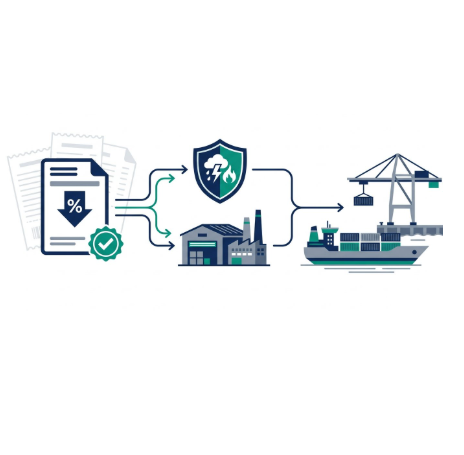
The issuance of Decision No. 151/QD-BTC in the very first month of 2026 takes place amid the Customs sector's accelerated restructuring of operational workflows, linking institutional reform with comprehensive digital transformation and streamlining organizational apparatus under the Regional Customs Sub-department model. Alongside this, extreme weather fluctuations, natural disasters, fire incidents, or unexpected accidents across international logistics supply chains constantly pose risks of damaging or destroying exported and imported goods under customs supervision. Against this backdrop, promptly refining the legal corridor on duty reduction and eliminating paper-based administrative procedures regarding receipts is an urgent requirement to remove barriers for enterprises and enhance state management effectiveness.
Urgency and Superior Innovations Compared to Previous Regulations
The urgency of Decision No. 151/QD-BTC stems from two primary drivers: fundamental changes in laws on electronic invoices and documents, and the requirement to synchronize settlement authority for duty reduction procedures following the organizational restructuring of the Customs sector. Prior to January 27, 2026, the group of procedures related to tax, fee, and charge collection receipts of international air express delivery enterprises and the customs authority was governed by legacy provisions in Decision No. 2770/QD-BTC of 2015 and Decision No. 1913/QD-BTC of 2025. Following the Government's issuance of Decree No. 70/2025/ND-CP and the Ministry of Finance's issuance of Circular No. 113/2025/TT-BTC—which decisively shifted receipt issuance, management, and usage onto an electronic platform with automated data connectivity—continuing to maintain manual notification and reporting administrative procedures became obsolete, creating unnecessary compliance burdens for businesses.
Placed in direct comparison with the previous regulatory system in Decision No. 2770/QD-BTC, Decision No. 764/QD-BTC, and Decision No. 1913/QD-BTC, Decision No. 151/QD-BTC introduces four superior innovations that thoroughly resolve practical overlaps and obstacles:
- First, the Decision definitively eliminates 05 administrative procedures concerning tax, fee, and charge collection receipts that no longer align with digital transformation requirements, comprising: Notification of Receipt Issuance (Code 1.007905); Notification of Receipt Destruction Results (Code 1.007906); Inspection of Printing, Issuance, Management, and Use of Receipts (Code 1.007908); Reporting on the Usage Status of Tax, Fee, and Charge Collection Receipts (Code 1.013656); and Reporting on Pre-Printed and Self-Printed Receipts in Cases of Loss, Fire, or Damage (Code 1.013658). Completely abolishing these 05 procedures enables international air express delivery enterprises and related units to end the practice of preparing periodic or ad-hoc paper reports on pre-printed and self-printed receipt forms as required previously.
- Second, regarding the structure of focal points for settling duty reduction policies, Decision No. 151/QD-BTC intelligently consolidates 02 separate procedures into a single unified procedure. Previously, under Decision No. 764/QD-BTC dated April 5, 2021, the Ministry of Finance announced two separate procedures in parallel: the Export and Import Duty Reduction Procedure (Code 1.007662) and the Clearance-Stage Export and Import Duty Reduction Procedure under the authority of Customs Sub-departments (Code 1.007661). Decision No. 151/QD-BTC now officially abolishes Procedure Code 1.007661 and integrates the entire duty reduction settlement workflow—both during customs procedures and post-customs procedures—into a single unified focal point under Procedure Code 1.007662. This consolidation allows taxpayers to easily look up information and uniformly apply dossier components and forms without fragmented requirements across two different workflows.
- Third, the Decision standardizes and clearly delineates settlement authority in accordance with the new organizational model of the Customs sector featuring two direct enforcement levels—Regional Customs Sub-departments and Border-Gate/Non-Border-Gate Customs units—replacing legacy unit designations in Decision No. 764/QD-BTC. This delegation mechanism ensures the principle of clear personnel, clear tasks, and clear accountability: units directly supervising and clearing goods at border gates immediately handle losses arising during clearance, while Regional Customs Sub-departments are responsible for in-depth appraisal and issuing duty reduction decisions for cases arising post-clearance.
- Fourth, regarding transaction methods and electronic data standardization, the new duty reduction procedure allows taxpayers to submit Written Requests for Duty Reduction directly via the Customs Electronic Data Processing System using the data fields prescribed in Form No. 3, Appendix VIIa promulgated together with Decree No. 18/2021/ND-CP, alongside options to submit paper copies using Form No. 08, Appendix VII or send dossiers via postal services. The entire reception and settlement process maintains a zero-dong fee, providing maximum financial support to enterprises at the exact moment they suffer cargo damage risks.
Detailed Regulations on Conditions, Dossiers, Implementation Sequences, and Settlement Authority
To ensure export and import duty reduction policies are applied accurately and transparently, Decision No. 151/QD-BTC specifies every constituent element of Administrative Procedure Code 1.007662 pursuant to Clause 1, Article 18 of Law on Export and Import Duties No. 107/2016/QH13 and Article 32 of Decree No. 134/2016/ND-CP (as amended and supplemented by Clause 16, Article 1 of Decree No. 18/2021/ND-CP).
Regarding applicable subjects and conditions, the procedure applies to organizations and individuals whose exported or imported goods are under the supervision of the customs authority pursuant to the 2014 Law on Customs and its guiding implementation documents, but are unfortunately damaged or lost due to objective causes such as natural disasters, catastrophes, epidemics, fires, or unexpected accidents. The reduced duty amount corresponds to the actual loss ratio of the goods.
Regarding dossier components (01 set), taxpayers must prepare four core groups of legal documents to prove objectivity and the actual extent of damage:
- Taxpayer's Written Request for Duty Reduction: Submit 01 original copy via the Customs Electronic Data Processing System using the data criteria in Form No. 3, Appendix VIIa, or prepare it according to Form No. 08, Appendix VII promulgated together with Decree No. 18/2021/ND-CP (Form No. 08 is used when submitting at the time of carrying out customs procedures). The request clearly declares organization/individual details, tax identification number, customs declaration number, dutiable value, loss ratio, tax type, and requested tax reduction amount.
- Insurance or carrier compensation documents (01 copy, if any): Insurance contract and compensation payment notice from the insurer (where the insurance contract does not cover tax compensation, confirmation from the insurance organization is required); or carrier compensation contract or settlement record where the loss was caused by the carrier.
- Record confirming the cause of damage issued by functional agencies in the locality where the damage occurred (01 original copy): Specifically, a fire confirmation record issued by the local fire prevention and fighting police agency where the fire occurred; or a written confirmation from one of the relevant agencies or organizations at the location of the force majeure event (commune, ward, or township Police; commune, ward, or township People's Committee; Management Boards of industrial parks, export processing zones, economic zones, hi-tech parks, or border gates; Maritime Port Authority; or Airports Authority).
- Inspection certificate (01 original copy): Issued by a commercial inspection service provider, specifically certifying the lost quantity of goods or the actual loss ratio of the goods as the basis for calculating the duty reduction amount.
Regarding implementation methods and sequences, taxpayers may choose to submit dossiers via the Customs Electronic Data Processing System, in person at the customs authority's headquarters, or via postal services. The settlement workflow is separated into two clear operational streams corresponding to the timing of dossier submission:
- The first stream applies where the taxpayer submits the duty reduction request dossier at the time of carrying out customs procedures. The taxpayer sends the dossier to the Border-Gate Customs or Non-Border-Gate Customs unit where customs procedures are being conducted. The customs authority where procedures are carried out receives and examines the dossier, conducts physical inspection of the damaged goods, and cross-checks duty reduction conditions. Dossier examination and physical inspection of goods strictly adhere to the timelines stipulated in Article 23 of the Law on Customs: completing dossier examination no later than 02 working hours from the time of receiving a complete customs dossier; and completing physical inspection of goods no later than 08 working hours from the time the customs declarant fully presents the goods (for shipments with large quantities, diverse categories, or high complexity, the Head of the customs authority decides on an extension not exceeding 02 days; where specialized inspection is required, the timeline is calculated from the receipt of specialized inspection results). Notably, the customs authority arranges processing even on public holidays, weekends, and outside working hours to ensure cargo handling and release schedules. Within the customs procedure time limit (and no later than 15 days from the date of receiving a complete dossier), Border-Gate/Non-Border-Gate Customs immediately grants the duty reduction or notifies the taxpayer in writing of the reasons for ineligibility.
- The second stream applies where the taxpayer submits the duty reduction request dossier after the time of carrying out customs procedures (while goods remain under customs supervision or when force majeure damage is discovered post-clearance as prescribed). The taxpayer submits the dossier to the Regional Customs Sub-department. The Regional Customs Sub-department receives and checks the accuracy and completeness of the dossier; if incomplete, it notifies and guides the taxpayer to supplement the dossier within 03 working days from the date of receipt. Within 30 days from the date of receiving a complete dossier, the Regional Customs Sub-department appraises the dossier and issues a Decision of the Head of the Regional Customs Sub-department on duty reduction, or notifies the reasons for ineligibility and the payable tax amount. Where goods have already passed through the customs supervision area and physical inspection is needed to establish sufficient grounds for settlement, the Regional Customs Sub-department issues a decision on post-clearance audit at the taxpayer's premises and completes the entire duty reduction settlement within a maximum timeline of 40 days from the date of receiving a complete dossier.
Assignment of Enforcement Responsibilities and Sector-Wide Coordination Mechanisms
To ensure Decision No. 151/QD-BTC enters into practice uniformly right from January 27, 2026, Article 3 of the Decision assigns concrete responsibilities to the Director General of the Department of Customs, the Chief of the Ministry of Finance Office, Heads of Regional Customs Sub-departments, and Heads of relevant units for strict enforcement.
Specifically, operational advisory units under the Department of Customs (with the Customs Tax Operations Board at the core) play the role of providing professional guidance, updating operational workflows on the Customs Electronic Data Processing System, and monitoring, consolidating, and promptly resolving obstacles arising during local implementation. The Ministry of Finance Office and the Department of Customs publicly disclose the full contents of the administrative procedure on the National Database on Administrative Procedures and the sector's electronic portal so citizens and businesses can easily look up and access information.
At the direct dossier-settlement level, responsibilities are clearly delineated under the principle of no responsibility-shifting and no overlapping authority. Border-Gate Customs and Non-Border-Gate Customs bear comprehensive responsibility for duty reduction request dossiers submitted right at the time of carrying out customs procedures, directly supervising and certifying actual loss status on-site and deciding on timely duty reductions to avoid bottlenecks in cargo circulation. Meanwhile, Regional Customs Sub-departments take the lead in appraising dossiers submitted after customs procedures, organizing on-site post-clearance audits at taxpayers' premises when necessary, and ensuring strict compliance with the prescribed 30-day or 40-day milestones. Additionally, Regional Customs Sub-departments and customs units at all levels cease requiring enterprises to perform the 05 abolished reporting and notification procedures regarding tax, fee, and charge collection receipts, transitioning to automated supervision via electronic receipt data under Decree No. 70/2025/ND-CP and Circular No. 113/2025/TT-BTC.
Policy Impact Assessment and Expected Performance Benchmarks
Synchronous implementation of Decision No. 151/QD-BTC delivers positive impacts across two dimensions: directly supporting the business community in cutting compliance costs and recovering cash flow when encountering risks, and enhancing the effectiveness and efficiency of state budget revenue management by the Customs authority.
For the import-export business community and international air express delivery service providers, the most immediate benefit is the complete elimination of 05 administrative procedures concerning tax, fee, and charge collection receipts. Enterprises no longer expend human resources, time, and administrative costs on preparing issuance notifications, receipt destruction result notifications, or periodic usage reports for paper receipts. Concurrently, under the Export and Import Duty Reduction Procedure (Code 1.007662), enterprises benefit from a clear "single-window" mechanism, a zero-dong fee, and full online submission via the Customs Electronic Data Processing System. When goods suffer natural disasters, fires, or unexpected accidents within customs supervision areas, dossier examination within just 02 working hours and physical inspection within 08 working hours at border gates enable enterprises to quickly complete procedures, minimize warehousing and storage fees, and preserve working capital for production reinvestment.
For the Customs authority, consolidating 02 duty reduction procedures into a single procedure and standardizing inspection certificates and cause-of-damage confirmations from local functional agencies unify review criteria nationwide. This mechanism both prevents the risk of abusing duty reduction policies for fraud and tax evasion, and frees customs officers from manual receipt report checks and reconciliations—focusing human resources on risk analysis and modern tax management.
Based on the reduction from 07 previous related administrative procedures (comprising 05 receipt procedures and 02 duty reduction procedures) down to 01 single administrative procedure (equivalent to an 85.7% reduction in procedural focal points within this operational group), combined with shortening clearance-stage inspection timelines to 02 hours for dossiers and 08 hours for physical goods alongside the Ministry of Finance's 2025–2026 administrative reform orientation to cut at least 30% of settlement times and compliance costs, expected impact and performance targets under Decision No. 151/QD-BTC are projected at specific quantitative levels:
- Reduction rate in administrative procedure focal points within the receipt management and duty reduction operational group: Reaches 85.7% (reduced from 07 procedures down to 01 single procedure under Code 1.007662).
- Rate of duty reduction request dossiers submitted electronically (via the Customs Electronic Data Processing System): Projected to reach approximately 85% to 95% of total dossiers arising nationwide.
- Rate of dossiers settled on or ahead of prescribed deadlines: Estimated to reach 98% to 100% (ensuring dossier examination is completed within 02 working hours, physical inspection within 08 working hours at border gates, and within 30 to 40 days for post-clearance submissions).
- Savings in enterprise dossier preparation and procedural execution time: Projected to decrease by approximately 40% to 55% compared to previously, thanks to completely eliminating periodic receipt reporting and notification steps and simplifying duty reduction reception focal points.
- Savings in administrative compliance costs (printing, paper archiving, travel, and port storage while awaiting clearance): Estimated to drop by approximately 35% to 50% for the import-export business community and international air express delivery enterprises.
- Scope and degree of synchronous rollout: Reaches 100% across all Regional Customs Sub-departments, Border-Gate Customs, and Non-Border-Gate Customs units nationwide right from January 27, 2026.
Implementation Roadmap and Next Steps
To ensure the superior provisions of Decision No. 151/QD-BTC achieve maximum effectiveness in practice, local customs units need to continue stepping up outreach and customs–business dialogues, guiding taxpayers to master electronic declaration workflows using Form No. 3, Appendix VIIa and Form No. 08, Appendix VII of Decree No. 18/2021/ND-CP, as well as reminding them to gather complete damage confirmation records and inspection certificates immediately upon the occurrence of force majeure incidents. Proactiveness on the part of the business community, combined with the professional and transparent service spirit of the Customs force, will create vital momentum to foster a favorable, safe, and sustainable investment and business environment in the new phase.
Most Recent Bài viết
Bài viết

|
A Quick Intro |
Search Trade Information
|
|
|
|
|
|
|
|
|
|
|
|
|
|


Feature Information
|
|
|
|
|
|
|
|
|
|
|


Information & Articles
|
|
|
|
|
|
|
|
|
|
|


