
Latest articles
WCO supports countries of the EAC in revising rules of origin and developing autonomous training capacities

- The East Africa Community (EAC) has revised its rules of origin to enhance the utilization of the Community preferential trade agreement, increasing trade operators’ compliance and supporting regional integration.
- New provisions on self-certification, cumulation and fairs and exhibitions have also been added to the FTA.
- A capacity building programme has been developed and a pool of trainers has been created to ensure those in charge of implementing the new rules and provisions are well-informed and trained for their use.
Organized under the framework of the EU-WCO Rules of Origin Africa Programme, 25 Customs officers from the eight Partner States of the East Africa Community (EAC) convened in Mombasa, Kenya, for a Training of Trainers on rules of origin. Under the European Union funded programme, this activity was the last of a two-year work programme which started in 2025 with the aim of revising the EAC rules of origin and strengthening Customs officers’ and trade operators’ capacity to implement them.
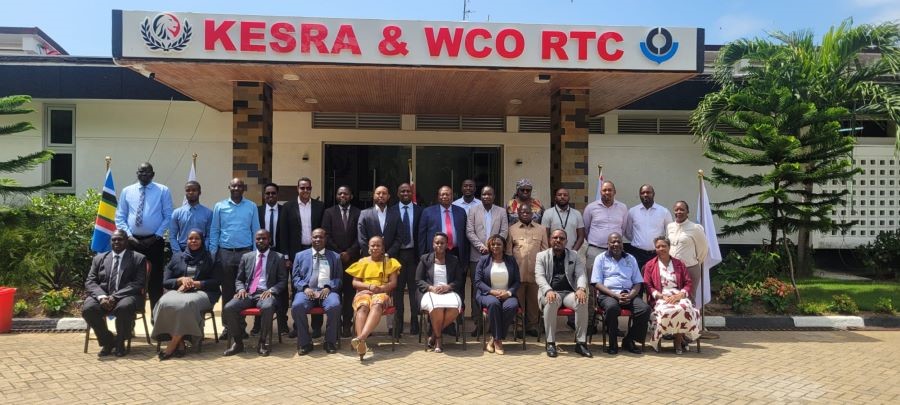
(Participants attending the training course)
How a WCO Study triggered change for rules of origin in the EAC
In 2024, the WCO had published the Comparative Study on Applicable Preferential Rules of Origin in the Eastern and Southern Africa (ESA) Region which provided a comparative analysis of origin provisions in a region which has the most numerous and complex overlapping trade regimes of the entire African continent. It revealed substantial disparities between origin regimes, resulting in significant differences when it comes to determining the origin of goods, and leading to fragmentation of markets and higher compliance costs for economic operators. Such complexity also results in an underutilization of preferences, highlighting the need for convergence towards a more favorable business environment.
The Secretariat of the EAC took note of the study findings and decided to review the rules of origin of its Free Trade Agreement (FTA) to align them with rules of origin used in other FTAs signed by its partners. To do so, it requested the support of the WCO and a collaboration started in March 2025 under the EU-WCO Rules of Origin Africa Programme, which resulted in not only revised EAC Rules of Origin but also with a Manual for the Application of the EAC Rules of Origin and a Capacity Building programme.
Clearer, simpler and more practical rules of origin
The revision brought significant improvements in terms of clarity, simplicity and practicality of the general provisions. New definitions of technical terms have been added, some existing definitions have been reformulated to align them to international standards, words that were either vague or inaccurate have been replaced, and more products have been included in some lists.
Finally, to support the modernisation of origin procedures, provisions on critical tools have been added. These include self-certification provisions enabling trade operators to self-issue proof of origin through a declaration that attests to the originating status of goods. The revised EAC rules also provide manufacturers with a new possibility to cumulate working processes, which is expected to support growth of regional value chains. Supporting provisions to this category of cumulation were also included, key among them being a new Schedule on Administrative Cooperation Agreements. A provision on fairs and exhibitions was also inserted, which is a useful derogation to the direct transport rule, considering the growth of trade fairs and exhibitions in the EAC Region.
The structure of the revised EAC rules of origin comprise of general provisions (Rule 1-38) and eight Schedules, including list of product specific rules, EAC Certificate of Origin, EAC Certificate of Origin for goods whose value does not exceed USD 2,000; Suppliers/Producers Declarations; Origin Declarations; Verification of Origin Form; EAC Information Certificate; and Administrative Cooperation Agreement on Cumulation.
Building autonomous training capacities
To support the implementation of the new rules, a Manual for the Application of the Revised EAC Rules of Origin was developed and will be made publicly available on the websites of the EAC Secretariat and of its Member Customs administrations.
A capacity building programme has also been developed to ensure effective and harmonized implementation of the rules across all EAC countries. It is aligned with the training strategy developed by the EU-WCO Rules of Origin Africa Programme which defines four stages of learning and is learner-centered to ensure participants gain measurable and verifiable knowledge and skills. It also makes use of the Rules of Origin Training Package and its standardized training agendas and materials, while providing for exercises and case studies adapted to the EAC region.
In October 2026, WCO experts trained 25 Customs officers and other government officials which now form a pool of trainers who will cascade knowledge and support the delivery of the capacity building programme at national levels.
Customs administrations in the EAC are now ready to support businesses to comply with the revised RoO and benefit from preferential market access.
(https://www.wcoomd.org/en/media/newsroom/2026/november/wco-supports-countries-of-the-eac.aspx)
Most Recent Bài viết
| Title | Category | Created On |
|---|---|---|
| WCO’s Operation DEMETER XII: Waste Trafficking is Growing, but so is the Customs Crackdown | General | 2026-11-27 16:46:33 |
| WCO supports countries of the EAC in revising rules of origin and developing autonomous training capacities | General | 2026-11-27 16:43:18 |
| Standardizing the Import and Export Duty Reduction Procedure and Abolishing Obsolete Receipt Regulations under Decision No. 151/QD-BTC | General | 2026-11-27 11:13:00 |
| Restructuring and Digitalizing the Export and Import Duty Refund Procedure under Decision No. 1768/QD-BTC | General | 2026-11-27 11:06:08 |
| Standardizing and Digitalizing the Extension Procedure for Payment of Taxes, Other Revenues, Late Payment Interest, and Fines in the Customs Sector under Decision No. 1768/QD-BTC | General | 2026-11-27 11:00:34 |
Bài viết

|
A Quick Intro |
Search Trade Information
|
|
|
|
|
|
|
|
|
|
|
|
|
|


Feature Information
|
|
|
|
|
|
|
|
|
|
|


Information & Articles
|
|
|
|
|
|
|
|
|
|
|


